| * VH Audio * | By Chris VenHaus |
|
Photography Pages Audiophile Pages
Photography Pages Audiophile Pages
Photography Pages Audiophile Pages
Photography Pages Audiophile Pages
Photography Pages Audiophile Pages
Photography Pages Audiophile Pages
Photography Pages Audiophile Pages
|
These Fine Silver Interconnects recently bested a set of well known $800+ interconnects at "WADStock" in Maidenhead, U.K. THIS RECIPE HAS BEEN UPDATED TO REFLECT NEW MATERIAL THAT HAS BECOME AVAILABLE! VH Audio has introduced both 24 AWG and 28 AWG cotton insulated UniCrystal OCC .99999 purity silver wire. This wire is the result of a new process that draws the wire to physical tolerances that are at least five times tighter than most wire manufacturers. In listening tests this was found to be as important as wire purity, when used for interconnects. This .99999 purity silver wire is insulated with four alternating layers of natural cotton insulation, which means minimal dielectric absorption. The individual fibers make minimal contact with the surface area of the silver. An advantage of cotton insulation is its dampening and non-resonant properties. Build your own IC with this wire and have a truly world-class IC... The VH Audio HyperFlex tubing, used as a core is also essential to get the best performance. The days of using rigid solid teflon tubing that kinks and breaks your wire are long gone ;-) Although I found my (original) "caulk-backer" DIY Interconnect to sonically better anything else I have tried (virtually everything out there), I was not satisfied with the "durability" of the foam caulk backer- it just wouldn't pass the audiophile "durability" test (connecting/removing the IC many times). By using the HyperFlex Fluoropolymer tubing in lieu of the caulk backer, I believe this recipe comes closest to the "ideal" COST NO OBJECT interconnect, based on it's inherently low capacitance design and use of quality (and AFFORDABLE) materials. I have been contacted by a gentleman who made these IC's and he measured the capacitance at an astonishingly low 3.5 pF per foot, and 200 mH of total inductance! The results wre obtained by using a 100k Ohm load on one end of the IC, and the reading taken at the other end. If you follow the instructions EXACTLY as posted, you will have a world-class performing IC. My construction goals were as follows: * Ultra-low capacitance (there is a direct correlation with capacitance and signal rise-time, with interconnects) * UniCrystal OCC .99999 Solid Core Silver Wire w/ Cotton insulation to minimize skin-effect/time-smear and dielectric absorption, and maximize vibration dampening. * A dielectric that has outstanding mechanical properties. Loose, raw cotton has a dielectric constant of 1.3-1.4 vs. 2.0-2.1 for solid teflon. It also is less susceptible to static charge and behaves very well as a mechanical dampener.
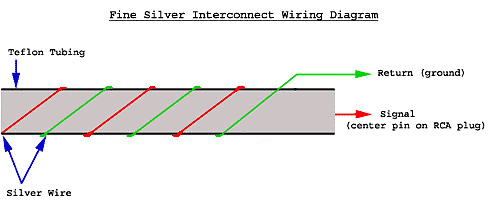
1/4" diameter HyperFlex Teflon tubing. Source: VH Audio Approx. Cost: $6 per running foot 1 roll (25 ft.) of 24 AWG or 28 AWG UniCrystal Silver Cotton Insulated wire Source: VH Audio 4 quality RCA plugs: ETI Silver RCA Plugs, or WBT Silver NEXTGEN plugs get the best performance. DON'T try to cut costs on the RCA plug, or you may be disappointed! Good solder: WBT silver solder works great). 3-4 rolls of Teflon tape (the kind plumbers use) 1/4" Nylon Expandable Sleeving ************************************************************** Construction: Take 2 desired equal lengths of HyperFlex Tubing and mark-off in 2" increments (perpendicular to the length of the tubing). Cut 4 wires about 5" longer than the Tubing (this will vary depending on how long your IC is- allow for some "shrinkage"!)- you may want to practice with a piece of string first to determine the correct length . Tape one wire at the end of 1 Teflon Tube, and proceed to "spiral" the wire down the length of the tubing in such a manner as to "hit" your 2" marks. As soon as you reach the end of the tubing, secure the end of the wire with another piece of tape to that end of the tubing. Now, take the other wire and tape it onto the OPPOSITE side (but same end) of the tubing from which you started the first wire. Spiral it in the SAME direction so that it would be spaced BETWEEN the previous wire (imagine a 1" mark between your 2" marks). Secure the end, as with the first wire. You should now have a "DOUBLE HELIX" configuration around the tubing. Think of the stripes as they spiral down a candy-cane, the blue and red stripes on the old barber-shop "turn thingies" (what the heck are they called anyway?), or for the scientists out there- a strand of DNA. The wires should NEVER touch along the tubing, and should maintain a distance of about 1/4" from each other when compared to the perpendicular plane. You should have 1" spacing on the parallel plane (this is what gives us our ultra-low capacitance). Remove the tape and replace with about 1 1/4" of 1/2" heatshrink. This will secure the wires, and provide a somewhat rigid "platform" for the RCA connectors to "bite" into the body of the IC without nicking the wire. Secure/solder your RCA's to the tubing and wires (make sure that you know which wire is for center pin and which is for return/shield lead, you DO NOT want to short out your equipment!!!). You may also use some 3/4" Heatshrink around the RCA barrel and a few inches onto the Tubing for a nice, neat look. If you feel the need, you may also use Nylon expandable sleeving over the "whole works" for a neat, professional look, before you put the 3/4" heatshrink on.
That's it! You now have IC's that WILL rival ANY commercially-made,
high-end, snake-oil IC's out there, and at a very reasonable cost.
Other options & comments:
*DO NOT use inferior grades of silver. It may be tempting to go with cheaper silver (.999 or .9995), but it will affect sonic quality. I have found interconnects to be the most sensitive to metal purity. With fine AWG wire it is also VERY important to have it drawn precisely in special dies to tight tolerances. Otherwise it is my experience the varied diameter of the wire will also affect sonics. You are making IC's that have been found to compare favorably to commercial IC's that are priced > $1,000+ range- don't skimp on the materials!
* This cable design also works excellent for balanced ANALOG cables. I like to use the Furutech FP-601M and Furutech FP-602F XLR connectors with Rhodium plating.
* In some situations, you may experience problems with RF interference, due to the lack of shielding on this cable. If think you may have an RF problem, check out the VH Audio Pulsar double shielded interconnect here. This interconnect is available assembled, or the Pulsar Cu II or Pulsar Ag wire is available for you to DIY.
*** READ ABOUT MY NEW CABLES!!! ***
Good luck- and ENJOY THE TUNES!!!
Chris VenHaus
Would you like to review your "finished" interconnect?
Click here to write a Review
Questions or comments? Contact Chris VenHaus here
Legal Stuff:
|